

Introduction
The preschool years are a time of incredible growth and discovery. Children between the ages of 3 and 5 are naturally curious, eager to explore their surroundings, and constantly asking questions about how things work. This is why introducing STEM activities for preschoolers during these formative years can be so impactful. STEM—an acronym for Science, Technology, Engineering, and Mathematics—is more than just a set of academic subjects. It’s a way of thinking, problem-solving, and exploring the world through hands-on experiences that encourage young learners to investigate, experiment, and make connections. In early childhood education, STEM lays a strong foundation for lifelong learning by blending play with meaningful skill-building.
When preschoolers participate in STEM activities, they begin to understand fundamental concepts like cause and effect, patterns, measurements, and creative problem-solving. These skills are not only important for academic success later in life but also for developing confidence, resilience, and adaptability—qualities that benefit children in every aspect of their growth. For example, when a child builds a simple tower out of blocks, they are learning about balance, gravity, and design without even realizing it. Similarly, mixing colors in water teaches them early chemistry principles, while counting seeds during planting introduces them to basic math.
One of the biggest advantages of preschool STEM is that it doesn’t feel like “learning” in the traditional sense. Instead, it’s play-based and engaging, which means children stay interested and motivated. Activities like sink-or-float experiments, creating bridges from popsicle sticks, or going on a nature scavenger hunt transform everyday moments into exciting learning opportunities. They also encourage children to ask “why” and “how” questions—laying the foundation for critical thinking and scientific inquiry.
Parents and teachers can integrate STEM activities into daily routines without the need for expensive equipment or specialized materials. Simple household items, natural objects, and basic craft supplies are often all it takes to create an enriching learning experience. More importantly, these activities foster collaboration and communication, as children often work together to solve problems or share discoveries. By making STEM a regular part of a preschooler’s life, we not only prepare them for future academic challenges but also help them see learning as an exciting and rewarding journey.
In this article, we’ll explore a variety of engaging STEM activities designed specifically for ages 3–5, along with tips for creating a STEM-friendly environment at home or in the classroom. Whether you’re a parent, caregiver, or educator, you’ll find practical, fun, and easy-to-set-up ideas to spark curiosity, boost problem-solving skills, and inspire a lifelong love of discovery in your preschooler.
What is STEM for Preschoolers

STEM for preschoolers is the introduction of Science, Technology, Engineering, and Mathematics concepts in a playful, age-appropriate way that aligns with early childhood education principles. At its core, STEM is not about memorizing facts or solving complex equations—it’s about encouraging curiosity, exploration, and problem-solving. For young children between the ages of 3 and 5, STEM is woven into everyday experiences, turning simple activities into powerful learning opportunities.
In early education, STEM looks very different compared to the way older students experience it. For preschoolers, it’s less about formal lessons and more about hands-on discovery. Activities such as stacking blocks, observing insects in the garden, mixing colors with water, or building a bridge from popsicle sticks are all examples of preschool STEM. These experiences help children grasp basic scientific concepts like gravity, cause and effect, and patterns, without them even realizing they are learning.
One of the key goals of STEM for preschoolers is to develop a “learning mindset.” This means fostering skills such as critical thinking, creativity, perseverance, and the ability to ask and answer questions. For example, when a child wonders why some objects float while others sink, they are naturally engaging in scientific inquiry. When they try to solve a puzzle or construct a tower that won’t fall over, they are exploring engineering principles.
Technology in preschool STEM doesn’t necessarily mean computers or tablets—it can be as simple as learning how to use a magnifying glass to explore nature or figuring out how a simple mechanical toy works. Engineering might involve creating ramps for toy cars, while mathematics can be introduced through counting games, shape sorting, or comparing sizes. Science often comes into play through experiments like planting seeds and observing their growth over time.
By introducing STEM education early, we give children the tools to think logically, work collaboratively, and approach challenges with confidence. The beauty of STEM for preschoolers is that it blends seamlessly into play, making learning both enjoyable and meaningful. When educators and parents understand that every question a child asks is an opportunity for exploration, they can turn daily activities into stepping stones for lifelong curiosity and success.
Benefits of Preschool STEM Learning

Introducing preschool STEM into a child’s daily routine offers far-reaching benefits that go beyond basic academics. During the ages of 3 to 5, children’s brains are developing at an incredible pace, forming connections that shape how they think, solve problems, and interact with the world. STEM education during this period not only builds foundational knowledge in science, technology, engineering, and mathematics but also nurtures essential life skills that will serve children well throughout school and beyond.
Encourages Critical Thinking and Problem-Solving
STEM activities require children to think, test, and adjust their ideas. For example, when building a tower from blocks, they might experiment with different shapes and sizes to make it more stable. This trial-and-error process teaches persistence and problem-solving—key skills for future learning.
Fosters Creativity and Innovation
Contrary to the belief that STEM is purely logical, it’s also deeply creative. Designing a simple bridge with household materials, inventing a new game, or experimenting with colors in water all encourage innovation. Children learn to think outside the box, which is just as important as following instructions.
Builds a Strong Foundation for Future Education
Early exposure to concepts like counting, measuring, observing, and experimenting creates a solid base for future STEM learning in primary school and beyond. Children who are familiar with these ideas tend to adapt more easily to formal education because they already understand the basics through hands-on play.
Develops Communication and Teamwork Skills
Many preschool STEM activities involve working together, whether it’s building a group project or sharing materials during an experiment. This collaboration helps children learn how to communicate their ideas, listen to others, and solve problems as a team—valuable skills for life.
Improves Fine Motor and Cognitive Skills
Using tools, assembling parts, and manipulating objects during STEM play strengthens hand-eye coordination and fine motor skills. At the same time, planning a design, predicting outcomes, and remembering steps enhance cognitive development.
Promotes a Love for Learning
Because preschool STEM is play-based, it feels fun rather than like formal lessons. Children are more likely to develop a positive attitude toward learning when they see it as an exciting, rewarding, and self-driven process. This love of discovery can last a lifetime.
In short, preschool STEM learning equips children with far more than academic knowledge. It lays the groundwork for independence, resilience, and adaptability—skills that will help them thrive in a fast-changing world. By integrating STEM into early childhood education, parents and educators can inspire a generation of curious, confident, and capable learners.
More Alternative Links For You :
How to Start an Online Tutoring Business in 2025
Online Tutoring Jobs for Teens in 2025 – Best Platforms,Tips
What is Education – Definition Types And Importance
Easy STEM Activities for 3–5 Year Olds
Introducing STEM at an early age doesn’t require expensive kits or complex lessons. In fact, some of the best STEM activities for preschoolers can be done using everyday materials found at home or in the classroom. The goal is to make learning interactive, hands-on, and fun, so children can explore scientific and mathematical concepts without even realizing they’re “studying.” Here are some simple yet powerful ideas for preschool STEM that are perfect for children aged 3 to 5.
Sink or Float Experiment (Science)
Fill a tub or basin with water and collect a variety of small objects—plastic toys, spoons, leaves, coins, sponges. Ask your preschooler to predict whether each item will sink or float, then test it. This fun experiment introduces concepts like density, buoyancy, and observation skills.
Building with Blocks (Engineering)
Give children building blocks of various shapes and sizes and encourage them to construct towers, bridges, or houses. Through trial and error, they’ll learn about balance, stability, and basic structural engineering while improving fine motor coordination.
Color Mixing with Water (Science + Art)
Fill three clear cups with water—one with red food coloring, one with blue, and one with yellow. Using droppers, children can mix the colors in empty cups to see what new colors they can create. This teaches basic chemistry concepts and cause-and-effect relationships while also engaging creativity.
Nature Shape Hunt (Math + Science)
Take children outside with a list of shapes (circle, square, triangle) and challenge them to find natural objects that match. For example, a round stone, a square tile, or a triangle-shaped leaf. This activity strengthens observation skills, introduces geometry, and connects STEM learning with the environment.
Magnet Hunt (Technology + Science)
Provide a magnet and a tray of mixed items (paper clips, buttons, coins, plastic toys). Let your preschooler test each object to see if it’s magnetic. This encourages prediction-making and introduces the concept of magnetic fields in a simple way.
Paper Bridge Challenge (Engineering)
Give children sheets of paper and ask them to create a bridge between two blocks or books that can hold the weight of small objects like toy cars. They’ll discover how folding or layering paper can make it stronger, which introduces engineering principles in an age-appropriate way.
Planting Seeds (Science + Math)
Have preschoolers plant seeds in small pots and water them regularly. They can measure growth with a ruler, count leaves, and record changes over time. This activity teaches life cycles, responsibility, and data tracking.
DIY Rain Cloud in a Jar (Science)
Fill a clear jar with water, top it with shaving cream, and drop colored water onto the “cloud” using a dropper. Children can watch the colored water “rain” into the jar. This visually explains how clouds hold water and why it rains.
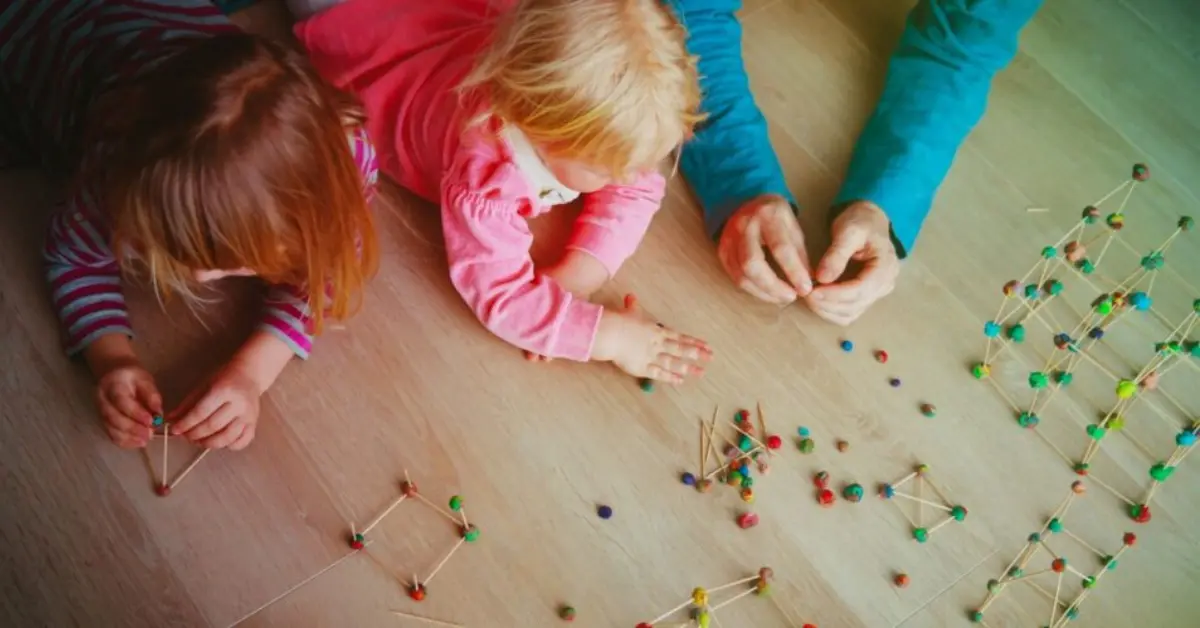
- Shape Building with Sticks and Clay (Engineering + Math)
Using popsicle sticks and modeling clay, challenge children to build different shapes—squares, triangles, rectangles—and then combine them to create 3D structures. This strengthens geometry skills and hand-eye coordination.
Sound Exploration (Science)
Use household items like pots, wooden spoons, rubber bands, and empty containers to create simple instruments. Let children explore how different objects produce different sounds, introducing them to the basics of vibration and sound waves.
These STEM activities for 3–5 year olds combine play with purposeful learning, making them perfect for home or preschool settings. They not only teach science, technology, engineering, and math concepts but also boost creativity, critical thinking, and problem-solving skills—ensuring that children build a strong foundation for future education.
How to Create a STEM-Friendly Environment at Home
Creating a STEM-friendly environment at home for preschoolers is less about filling the house with expensive equipment and more about fostering a space where curiosity, creativity, and problem-solving can thrive through everyday experiences. To begin with, parents and caregivers can dedicate a small corner or table as a “STEM zone,” stocked with basic yet versatile materials like building blocks, measuring cups, paper, crayons, scissors, tape, magnifying glasses, popsicle sticks, rubber bands, and recycled containers. These resources act as open-ended tools, encouraging children to explore concepts in science, technology, engineering, and math without even realizing they are engaging in early STEM education. A key element is accessibility—keep materials within the child’s reach so they can independently start a project whenever inspiration strikes, while still maintaining safety for items that require supervision. Integrating preschool STEM into daily routines is also essential; this can be as simple as counting steps while walking, observing cloud shapes during outdoor play, or asking “what do you think will happen if…” before trying a kitchen experiment together. Technology in this context doesn’t have to mean screens—simple tools like flashlights, timers, or magnifying glasses introduce children to basic principles of technology and encourage exploration. Nature can also be a powerful STEM classroom; a backyard, balcony garden, or nearby park can be used for activities like measuring plant growth, collecting different leaves, or studying insects. Parents should focus on asking open-ended questions that prompt thinking rather than giving immediate answers, as this strengthens problem-solving skills and scientific reasoning. Encouraging trial and error is vital—let children make predictions, test them, and adjust their ideas if something doesn’t work out, teaching resilience and adaptability. Collaboration should also be nurtured; invite siblings or friends to join in building projects or science experiments, which builds teamwork and communication skills. Most importantly, the environment should celebrate curiosity—displaying children’s creations, keeping a journal of their experiments, and acknowledging their questions reinforces the idea that learning is a rewarding process. By weaving STEM activities for preschoolers into the home environment in this way, parents create a space where discovery is part of everyday life, setting the stage for a lifelong love of exploration, innovation, and learning.
Tips for Teachers and Parents
- Whether you’re a teacher in a preschool classroom or a parent guiding your child’s early education at home, incorporating effective strategies can make STEM activities for preschoolers both enjoyable and impactful. One of the most important tips is to embrace a mindset of exploration rather than perfection. At this stage, children learn best when they’re encouraged to ask questions, experiment freely, and learn through trial and error. Instead of focusing on getting the “right” answer, celebrate curiosity and creativity, which helps build confidence and resilience. When children know it’s okay to make mistakes and try again, they develop problem-solving skills that will serve them well in all areas of life.
- Another key tip is to use everyday materials and familiar objects as tools for STEM learning. You don’t need expensive or specialized equipment to introduce foundational concepts in science, technology, engineering, and math. Simple items like cardboard boxes, plastic cups, string, paper clips, or even kitchen utensils can be transformed into exciting experiments and building projects. This accessibility not only saves resources but also shows children that STEM is all around them and part of their daily lives. For example, cooking together offers numerous STEM learning opportunities, such as measuring ingredients (math), observing chemical changes (science), and following sequences (technology and engineering).
- It’s also crucial to tailor STEM activities to the developmental level of preschoolers, keeping sessions short and engaging. Young children have limited attention spans, so breaking learning into bite-sized activities that last 10 to 15 minutes ensures they stay focused and interested. Repetition is beneficial, so don’t hesitate to revisit favorite experiments or projects, as this reinforces understanding and builds mastery. Incorporating movement and sensory play can also boost engagement; for example, hands-on activities like water play, sand exploration, or using playdough allow children to experience STEM concepts through multiple senses.
- Effective communication plays a big role in maximizing the benefits of STEM for preschoolers. Teachers and parents should ask open-ended questions like “What do you think will happen if…?” or “How can we solve this problem?” to encourage critical thinking and verbal expression. Listening carefully to children’s ideas and encouraging them to explain their thought process helps develop language skills and self-confidence. It’s equally important to model enthusiasm and curiosity yourself—children often mimic adult attitudes, so showing excitement about discoveries fosters a positive learning environment.
- Collaboration is another powerful tool in preschool STEM education. Group activities encourage children to share ideas, work together, and develop social skills alongside their scientific and mathematical understanding. Whether it’s building a block tower as a team or conducting a simple experiment in pairs, cooperative play helps children learn to negotiate, listen, and respect different perspectives. Teachers and parents can facilitate this by setting clear expectations and encouraging respectful communication during group work.
- Safety should always be a top priority when planning STEM activities for young children. Ensure all materials are age-appropriate and free from choking hazards. When using tools like scissors, magnifying glasses, or liquids, adult supervision is essential. Setting up a safe and organized workspace with clear boundaries helps children focus on learning without unnecessary distractions or risks.
- Finally, make STEM a regular part of your daily routine rather than an occasional activity. Consistency reinforces learning and helps children develop a habit of curiosity and investigation. Integrating STEM into storytime, outdoor play, art projects, and even simple chores makes education a seamless part of everyday life. By thoughtfully applying these tips, both teachers and parents can create enriching, fun, and effective STEM learning experiences that inspire preschoolers to explore the world with wonder and confidence.
Frequently Asked Questions (FAQs)
What does STEM stand for?
STEM stands for Science, Technology, Engineering, and Mathematics. It represents an integrated approach to learning these subjects through hands-on and practical activities.
Why is STEM important for preschoolers?
STEM helps preschoolers develop critical thinking, creativity, and problem-solving skills early on. It encourages curiosity and builds a strong foundation for future academic success.
What are some simple STEM activities suitable for 3-5 year olds?
Activities like sink-or-float experiments, building with blocks, color mixing, nature shape hunts, and magnet exploration are all great STEM projects for preschoolers.
Do preschool STEM activities require special materials or equipment?
No, many effective STEM activities can be done using common household items like cups, paper, blocks, magnets, and natural objects, making it accessible and affordable.
How can parents and teachers create a STEM-friendly environment at home or school?
By providing accessible materials, encouraging questions, supporting experimentation, and integrating STEM concepts into daily routines and play, adults can foster a rich STEM environment.
Conclusion
Introducing STEM activities for preschoolers is a wonderful way to nurture curiosity, creativity, and critical thinking from an early age. Through simple, hands-on experiences, children aged 3 to 5 can develop essential skills that prepare them for future learning and life challenges. By creating a supportive environment at home or school, and using everyday materials to explore science, technology, engineering, and math, parents and teachers can make STEM both fun and meaningful. Encouraging exploration, asking open-ended questions, and celebrating discovery will inspire preschoolers to become confident, lifelong learners.
Bonus Tips
- Use everyday household items for STEM activities.
- Keep sessions short and engaging (10-15 minutes).
- Encourage questions and curiosity.
- Let children learn through trial and error.
- Incorporate STEM into daily routines and play.
- Promote teamwork and sharing during activities.
- Always supervise for safety.
More Alternative Links For You :
How to Start an Online Tutoring Business in 2025
Online Tutoring Jobs for Teens in 2025 – Best Platforms,Tips
